
Diplomacy in shorts
By Irmak Ersöz & Anaïs Anqi Skok
Once upon a time, diplomacy was conducted by suits in ballrooms, mansions, and skyscrapers, where they discussed pressing international issues with elegance and gravity. But things are not so simple anymore. This summer, American hegemony moved foreign relations onto the field—literally.
When the FIFA World Cup made its way back to North America after 32 years, it collided with an American presidential administration marked by emotional policymaking, retaliative governance, and decidedly undiplomatic tendencies.
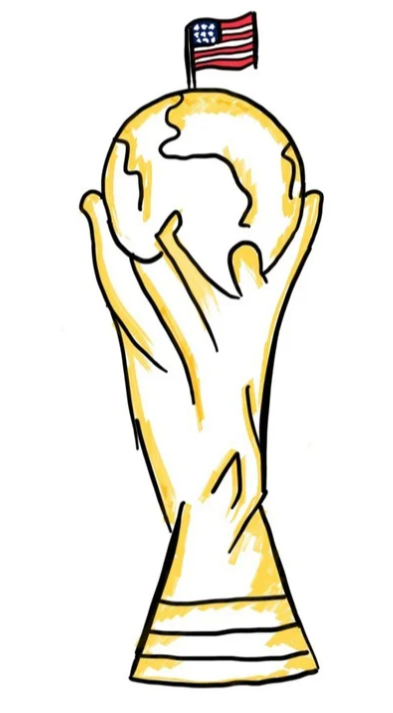
Hosted by Canada, Mexico, and the United States, this was the first FIFA World Cup played in multiple countries. However, any semblance of neighborly affection between co-hosts seemed to have cooled before the games even began. Severing long-lasting trade relations and slapping the name “America” on international bodies of waters didn’t help.
Yet, some teams would not have even gotten to play if it weren’t for the U.S.’ ex-bestie-made-co-hosts. Continuous military action in Iran was unsurprisingly coupled with restrictions for its football team. Despite obtaining visas to participate in the tournament, the Iranian team was precluded from staying overnight in the U.S. and was forced to commute from Mexico for each game—a proxy battle in the larger war taking place on the other side of the world.
Iran was in good company in its travel hiccups, as the U.S. extended a warm welcome to few. Haiti, the Ivory Coast, and Senegal faced partial-to-full entry bans into the U.S., forcing their fellow citizens to watch from afar.
Immigration woes didn’t just interfere with players this year. Omar Abdulkadir Artan was barred from making history as the World Cup’s first Somali referee when he was denied entry to the U.S. at Miami International Airport. Artan, whose home country has consistently drawn heavy criticism from the Trump administration, quickly made headlines for being rejected entry given that he holds a diplomatic passport. The White House claimed Artan was in communication with “bad actors,” and Trump’s wayward definition of the term only echoes his loud crackdown against countries he casts aside with ease.
We even saw controversy spark new alliances. In an attempt to put America “first,” Trump became the first head of state to publicly meddle in FIFA’s refereeing decisions, and everyone hated him for it. After a phone call with Trump, FIFA President Gianni Infantino’s decision to reverse the red card on America’s star player Folarin Balogun rallied the world behind the forthcoming opponent, Belgium. When Belgium prevailed against overt political interference to win 4-1, the world was reminded of why we love football. On the field, we set aside our differences. We just play.
The spirit of play showed itself in its purest form off the field, too. With Germans discovering 7-Eleven mega sodas, Scottish fans draining Boston’s beer supply, and small-town Americans making Europeans fall in love with ranch dressing, the FIFA World Cup once again reminded us all of our many similarities, even in the face of government manipulation.
Multilateralism—or whatever’s left of it—has organized the world into a complex web of blocs and formal institutions that seem to steer the fate of the world. Yet, this summer of football somewhat debunked the myth that diplomacy is carried out only in closed-off, faraway rooms. Every penalty kick, government intervention, and cross-cultural food discovery redefined what transnational interaction looks like in the modern day.
Institutions tried to decide who could enter stadiums, and even who got to win, but we’d like to believe that a worldwide love for the game somehow triumphed over that tampering. Maybe there’s hope for diplomacy after all—on grass fields, clad in Adidas shorts.