
How Türkiye Became a Women's Volleyball Country
By Eda Devletşah
For decades, football—specifically, men’s football—has unquestionably been considered Türkiye’s national sport. İstanbul’s biggest football clubs inspire intergenerational fan craze. During derby days, fan traffic shuts down the city, and restaurants and bars host rowdy viewing parties. The national team’s biggest matches turn the country into a sea of red and white, as households proudly hang Turkish flags from their windows.
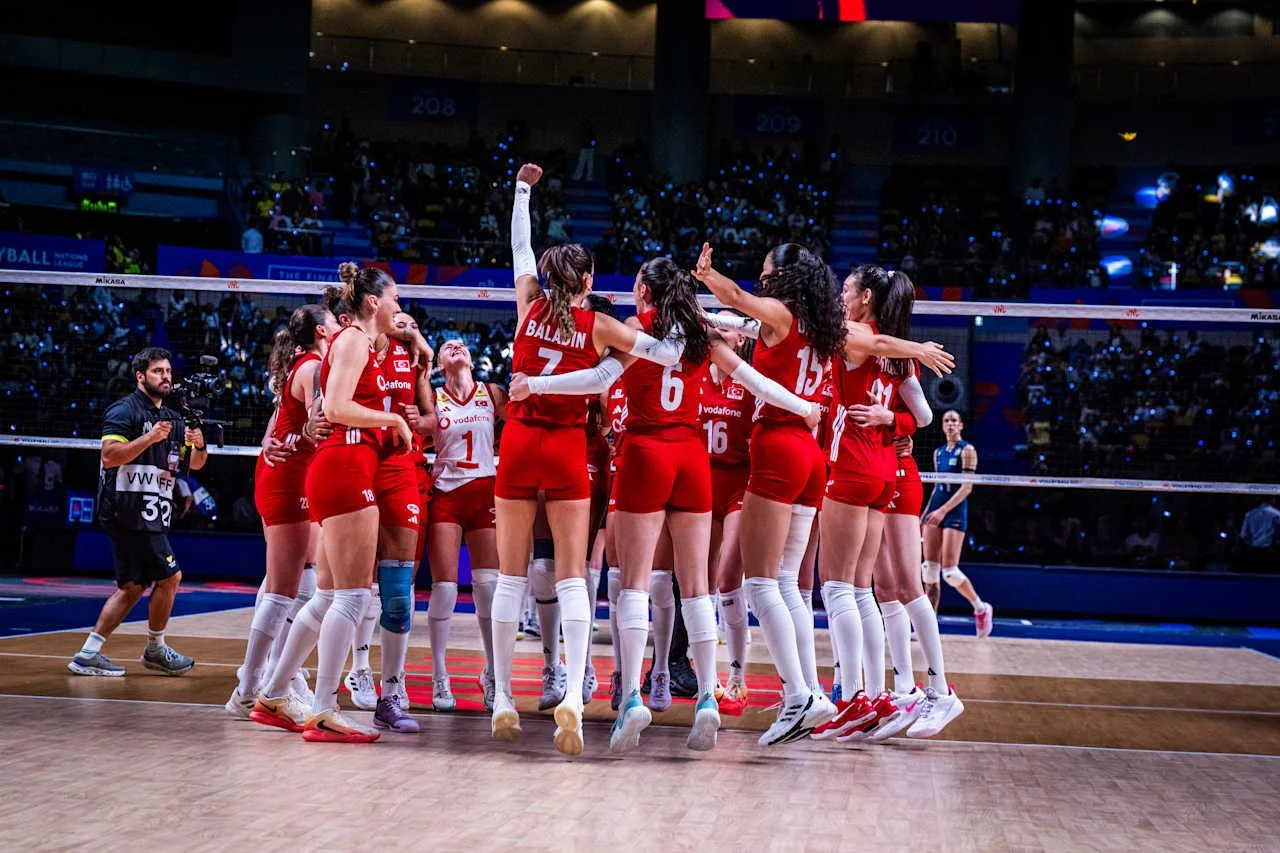
During the summer of 2026, however, the country’s most successful national team was a group of volleyball-playing women.
Dubbed “Sultans of the Net,” the Turkish Women’s National Volleyball Team defeated Brazil in July to win the Volleyball Nations League. Two months later, they did it again in front of more than 17,000 spectators in İstanbul. Türkiye defeated Italy, the reigning Olympic and world champion, in five sets, winning its second consecutive European championship and securing their ticket to the 2028 Olympics.
The summer of wins for Turkish women’s volleyball stands in stark contrast to the country’s football performance. In June, the men’s national football team returned to the World Cup for the first time since their legendary third-place finish in 2002. Despite enormous expectations, early upsets against Australia and Paraguay eliminated Türkiye in the group stage. The disappointment continued into the fall, with Türkiye losing consecutive UEFA Nations League matches to France and Italy.
The scoreboard, however, is only the most visible difference. Behind these contrasting results are two very different approaches to building sporting success. The Sultans of the Net’s success was the product of decades of proper investment, discipline, continuity, and meritocracy. Turkish football has struggled to replicate the same institutional foundation.
Long before the national team’s recent victories, Turkish clubs were building one of the strongest women’s volleyball systems in the world. Teams such as VakıfBank and Eczacıbaşı invested in professional women’s volleyball programs capable of competing with, and beating, Europe’s best clubs. A strong domestic league meant national-team players were training and competing at an elite level.
Below the professional level, the Turkish Volleyball Federation (TVF) developed a pipeline designed to identify and develop talent early. TVF organizes age-group leagues in schools, national championships, and national-team summer camps for young players. These institutionalized programs introduce youth to volleyball and raise the number of licensed athletes that later are adopted into the national team’s talent pool.
This long-term approach extends to the federation’s leadership. At its helm is Mehmet Akif Üstündağ, a former player and coach who spent years in the federation before becoming its president. Turkish Football Federation president İbrahim Hacıosmanoğlu, meanwhile, arrived at the same position without comparable experience on the pitch or sidelines. The disparity points to another ingredient in Turkish volleyball’s success: Continuity, discipline, and putting people with the right experience in the right positions matter.
While none of these TVF initiatives guarantee championships, they reveal that Turkish volleyball has chosen to invest in infrastructure, talent development, and institutional continuity. While Turkish football has historically commanded far more money and media attention, the difference between the two sports suggests that where money goes is perhaps more important than sheer financial scale.
The most important return on that investment is the generation watching from home. The impact of these initiatives begin long before a player reaches the national team. When young girls grow up seeing Eda Erdem, Zehra Güneş, and Melissa Vargas celebrated as national heroes, volleyball becomes more than a sport they watch. It becomes one they can imagine themselves playing. Generations of Turkish boys grow up wearing football jerseys and imitating their favorite players. Football has not had to convince boys that the sport belonged to them. Women’s volleyball has gradually built something similar for girls.
Representation in sports is not merely symbolic. Visibility feeds participation, which expands the talent pool, strengthening clubs and national teams. Subsequent successes attract audiences and sponsors, where resources can then be invested back into the sport.
By the time more than 17,000 people packed İstanbul’s Sinan Erdem Sports Hall for the European Championship final this September, women’s volleyball had entered the mainstream of Turkish sports.
The Sultans of the Net are unapologetically competitive, courageously loud, physically powerful, and internationally visible women. When they win, millions of Turks celebrate them not for conforming to the culture’s particular vision of femininity, but for serving harder, jumping higher, blocking better, and most importantly, winning.
A country historically reliant on men’s football for moments of sporting glory can finally look elsewhere for inspiration, entertainment, and hope. If this summer is any indication, the Sultans are more than ready to deliver.