
The ‘26 Knicks and the Midnight Bash in the Concrete Jungle
By Will Emmons
On the summer night of June 13, 2026, New York City walked onto the streets to collectively witness the end of a saga. The New York Knicks were hours away from the fifth game of the NBA Finals against the San Antonio Spurs. If they beat the Spurs, the Knicks would win the NBA championship—for the first time in 53 years.
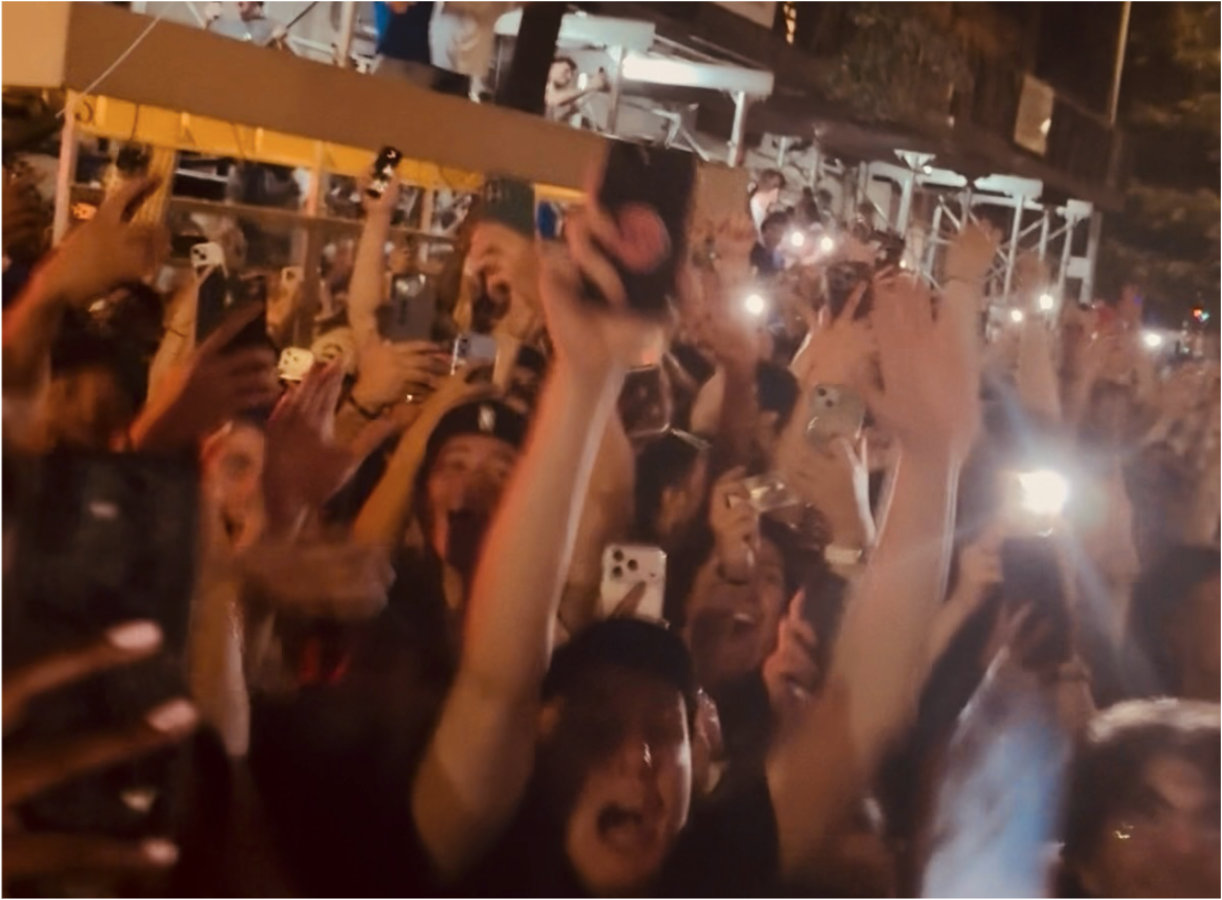
I met up with a group of SIPA students at an intersection in the West Village to watch the game amidst a dense, buzzing crowd of thousands. A projector propped up on a fire escape beamed the game at movie-theatre scale onto the brick wall of an adjacent townhouse.
This was the zenith of Knicks fever. But where had it come from? Why had this phenomenon lured us all into its orbit? Like anything else that truly compels people, it starts with a story. In this case, a comeback story.
At the heart of this tale was the team’s bond. In 2024, Jalen Brunson, captain of the Knicks, took a pay cut so the team could afford to hire talented players around him. The front office acquired Brunson’s old teammates from his college basketball days at Villanova. Jalen’s father Rick Brunson, a former Knick himself, also served as assistant coach. Heading into this season, the Knicks locker room was a tribe of family and friends. They would need these strong roots amid mounting pressure as they advanced closer to the finals. As Knicks owner James L. Dolan told them in a speech before the playoffs, this might be their best chance to win a championship in half a century. It might not come again.
As the team entered the finals against the Spurs, Knicks fans started to hope in a way they had not in a long time.
To understand the anticipation before Game Five, we have to appreciate the miracle of Game Four. In that game’s first half, the Knicks had fallen behind by a stomach-churning gap of 29 points. The Knicks stiffened their defense and slowly made one shot after another so that by the final seconds of the game, they were only behind by a single point. With hearts pounding in the stands and 1.2 seconds left on the clock, Brunson launched a final shot. As both teams sprinted towards the hoop, the ball landed on the rim and began to bounce away, taking the hopes of New York City with it.
But then, in just the Knick of time, an arm emerged from the clashing pile of bodies. With the light touch of a surgeon, Knicks forward OG Anunoby tapped the ball back into the basket—a move that our grandchildren will one day know as “The OG Tip-In.” The Knicks took the lead, the timer hit zero, and Madison Square Garden erupted.
What had just happened was extraordinary, but the Knicks had one more game to win. The city organized watch parties, put up decorations, and repeated the motto “Knicks in Five.” The Knicks’ saga unified total strangers in a shared awe of what we were witnessing. A sporting event had become a public service. If the Knicks won, we knew the celebration would be momentous—and we wanted to be part of it. So, as the sun began to set on game night, we stood on the street in the West Village to watch.
Like the game prior, the Knicks and the Spurs spent much of the night hovering within a few points of each other until the final minutes when the Knicks surged ahead.
When the last buzzer sounded and the game was won, the roar of the crowd was so loud that it felt like the whole street had gone mute. The rest of the night came in flashes: The rumble of thousands jumping up and down; screaming faces and a sea of hands pumping in the air; a downpour of champagne, beer, and confetti; dance parties screaming “Empire State of Mind” like it was a revolutionary anthem; strangers embracing, asking each other’s names and exchanging numbers. The only colors we could see were orange and blue.
As we took to the streets, the players celebrated in the locker room and a beaming Rick Brunson shared a hug with his son Jalen, now an NBA champion. With the unified cheers and gleaming lights of their city in the distance, the Knicks’ comeback story was complete.