
When Republicans and Communists Sat the City Council Together
by Damian Vladimiroff
In 1899, the Board of Aldermen—precursor to the New York City Council—wrangled with corruption allegations. The Board’s clerk had just finished reading out the resolution when Alderman Howard Okie, a member of the Citizens Union and a leader in the city’s reform movement, arose. He demanded that a one-man committee consisting of his Irish-American peer James Bridges, a stalwart in Manhattan’s infamous political machine Tammany Hall, travel to wherever flies the British flag. Laughter burst throughout the chamber.
“There [are] too many jokes on this floor of this board,” snarled Bridges. “The gentleman wants to send me to England, does he? I’d like to ask him if he’s willin’ to put his hand in his pocket and pay my fare!” Okie agreed—for a one-way voyage.
The raucous was caused by another resolution from the day before, proposed by Alderman Dennis Harrington, a Tammany loyalist and a proud Crown-scorning Irishman. Harrington’s resolution jokingly proposed raising the American flag in commemoration of Queen Victoria’s birthday, which the press regurgitated as him having wished to raise the Union Jack over City Hall. Local Irish-American organizations decried Harrington’s supposed betrayal while anglophile Orangeists as far as Toronto mistook his “support.”
Such was one of the more harmless episodes to consume the Aldermen’s many fruitless working days.
Around the turn of the century, municipal governance was rendered null. Legislative power was then divvied between the State’s vague but powerful oversight, the patrician Board of Estimate and Tammany. The Board of Aldermen was elected across 72 districts, which Tammany gamed through patronage and district party enforcers. Despite only earning electoral pluralities, machine-loyal Democrats, by custom swept, aldermanic elections. Enter Mayor Fiorello LaGuardia.
In 1933, the reform movement zenith LaGuardia encountered fierce opposition from Tammany, then reeling from anti-corruption backlash. The only path towards totally remedying a Depression-stricken New York, he determined, was to uproot “a Horse Car [City] Charter in an Airplane Age” under an electoral system novel to New York: Proportional representation (PR).
Nearly every reform organization supported the proposal. Conservative Republicans, civic organizations like the Citizens Union, renegade Democrats, The New York Times, and left-wing activists all rallied behind PR. By 1938, voters adopted LaGuardia’s charter empowering proportionally-elected councilmen, distributed by borough population, who counteracted the Board of Estimate comprising the Mayor and Borough Presidents.
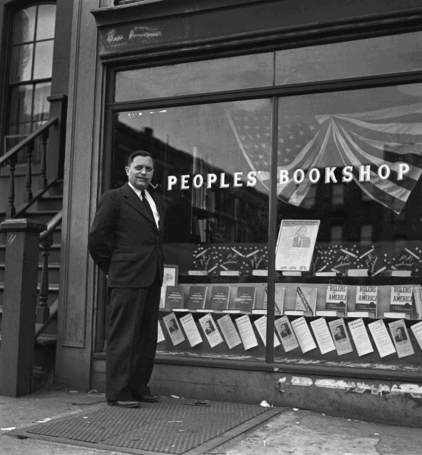
Peter Cacchione, a Communist councilman for Brooklyn, standing in front of his campaign headquarters. September 21, 1937. Daily World.
PR completely transformed city politics. In the 1933 election, Democrats’ 42.3 electoral plurality earned them 64 of the chamber’s seats; Republicans—one seat. But after several crushing Tammany defeats, by 1943, 17 percent of the Council comprised Republicans and welcomed the addition of the American Labor and Socialist parties. The new Council saw a great uptick in policy output, reaching its height in 1946; and it expedited much of LaGuardia’s progressive agenda, notably a watershed 1947 rent control bill.
PR also seated Communist councilmen for the first time, attracting reactionaries’ ire.
Criticism of PR and the newly-ensconced newcomers mounted quickly: One Bronx Democrat described the system as a “dangerous lottery.” Robert Moses, though affiliated with the Good Governance movement, testified in favor of eliminating proportional representation altogether. And so the question circulated among critics: was a seat alongside radicals preferable to no seat at all?
Democrats, and Republicans, riding the tide of the 1940s’ Red Scare, joined forces against the American Labor Party, the Communist Party, LaGuardia’s Fusion ticket, and City reformers to overturn PR. In 1947, following a swift, McCarthyist public relations campaign, proportional representation was overturned via referendum after hardly a decade in use.
LaGuardia’s City Council persists, but under Democratic supermajorities, despite the election of several mayors from different ideological cloths and party loyalties. However, contemporary reform has begun ushering in alternative means to the first-past-the-post elections that bolster one-party capture of city government. During the 2025 Democratic Primary, then-candidate Zohran Mamdani’s insurgent cross-endorsement strategy with former-Comptroller Brad Lander under ranked-choice voting, successfully boxed out former-Governor Andrew Cuomo, a longtime (though scandal-laden) political titan and the leading early contender for Mayor. And in May 2026, lawmakers proposed a bill to establish an exploratory committee on proportional representation.
In New York, political pluralism is de facto: though it may not be the norm in our elected chamber, it’s the reality among voters. And for a city grappling with debates over urban governance and inequality akin to those of the Reform Era, it’s worth considering forms of representation more conducive to cross-ideological debate.