
Mahmoud Khalil Returns to Campus
By Finn Maguire
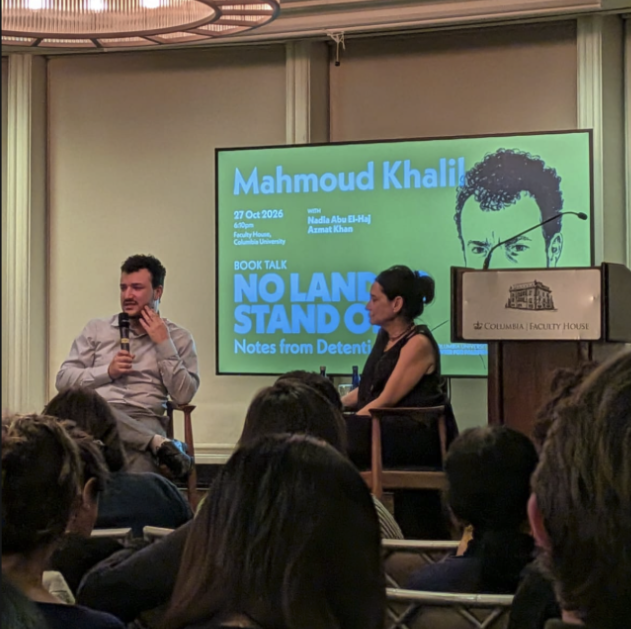
Mahmoud Khalil, a Palestinian activist who helped lead Columbia’s 2024 campus protests over the war in Gaza, returned to campus on October 27 for the first time since his arrest in March 2025. Roughly 100 people came to the university’s Faculty House to hear the 2024 SIPA graduate discuss his memoir, No Land to Stand On: Notes From Detention.
Security checked bags at the door. Inside, every seat was taken.
Nadia Abu El-Haj, the moderator, called it “probably the most important and meaningful” event she had organized. The Center for Palestine Studies, which she co-directs, co-hosted the talk with the Simon and June Li Center for Global Journalism.
In November 2025, the same organizers tried to bring Khalil to campus for a screening of “The Encampments,” a documentary about Columbia’s 2024 pro-Palestinian encampment. After “six weeks of negotiating with security,” Abu El-Haj said, they learned he “was not allowed on campus on security grounds.” Columbia’s public affairs office said at the time that it had recommended a different venue after a safety review.
This year’s talk drew criticism before it even began. In an Instagram video, actress Debra Messing called Khalil the negotiator for “the pro-terror side.” The National Jewish Advocacy Center asked the Justice Department to review whether the event violated Columbia’s $200 million settlement agreement with the Trump administration.
Columbia defended the event. “An invitation to speak does not signify university endorsement of a speaker’s views,” a university spokesperson said.
Khalil was a lead negotiator for the Gaza Solidarity Encampment, a protest camp on Columbia’s lawn in the spring of 2024. Negotiators pushed the university to cut its financial ties with Israel, but talks broke down and police cleared the camp. On March 8, 2025, non-uniformed Immigration and Customs Enforcement agents detained Khalil at his university-owned apartment.
A Department of Homeland Security spokesperson said Khalil had “led activities aligned to Hamas, a designated terrorist organization.” His lawyers rejected the claim, and officials offered no evidence for it. In court, the government made a different case.
The State Department sought to deport Khalil under a rarely used 1952 law, arguing his activism harmed U.S. foreign policy. Federal prosecutors never charged him with a crime.
Nonetheless, he spent 104 days in a Louisiana detention center, missing the birth of his son, before a federal judge ordered his release. His memoir draws on the diary he kept there.
Khalil spent much of the evening blaming the university for his arrest. Columbia, he told the audience, bore the main responsibility for what was happening to him. “It’s not the Trump administration,” he said. Without Columbia’s “disregard of our rights,” he argued, the government would not have targeted him.
In September, Khalil sued Columbia, its trustees, and SIPA Dean Keren Yarhi-Milo in federal court. The suit accused the university of “deliberate indifference” to the harassment of pro-Palestinian SIPA students. It also asked the court to restore the campus access Columbia denied him last year. Columbia declined to comment on pending litigation.
Khalil also said a vice provost told him during negotiations over the encampment that “[Dean Yarhi-Milo] is calling on us to bring police as soon as possible.”
“The depiction of these events is not accurate,” Yarhi-Milo said in a statement to The Morningside Post. A Columbia University spokesperson said the dean “was not involved in the negotiations with respect to the encampment or the decision to bring in the police.”
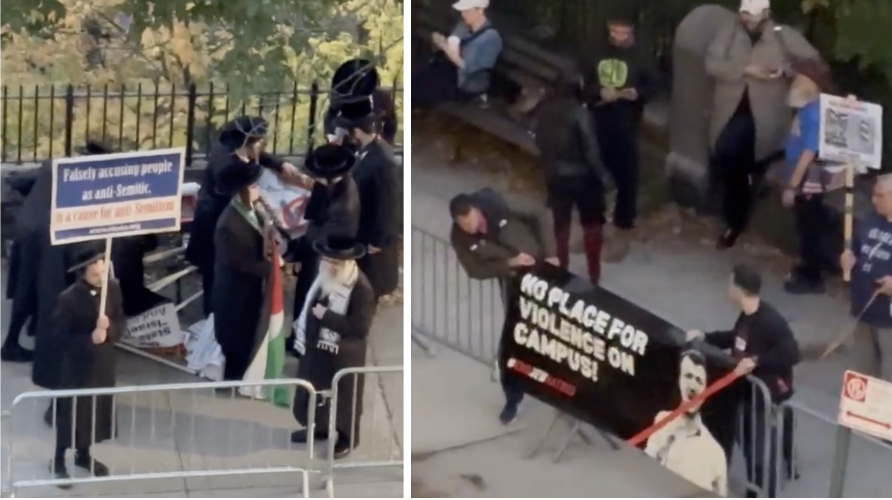
Throughout the talk, chants from two small groups of protesters outside carried into the room. Both stayed peaceful under a heavy police presence.
Eleven men in traditional Orthodox Jewish dress held signs that read “Falsely accusing people as anti-Semitic, is a cause for anti-Semitism” and “Anti-Israel is NOT Anti-Semitism.” Farther down the street, eight protesters gathered, some waving American flags. Two held a banner that read “No place for violence on campus! #EndJewHatred” next to a crossed-out photo of Khalil.