
Who Owns My Lunch?
by Nethra Jaygopal
I am not embarrassed to admit that I took part in New York’s line epidemic this summer. Mimi’s, Caffe Panna, Caffe Paradiso—I queued for all of them. As a reward, I had the brilliant opportunity to experience $12 frozen yogurt that tasted like expired sour candy. In each line I wondered, “Will this ruin every other frozen yogurt for me?” Don’t worry; it never did.
Worn out by the lines, I retreated uptown to my new neighborhood, Morningside Heights. I expected to escape them. I couldn’t—they just changed. Lines here snake out of Sweetgreen during lunch, or Blank Street for the morning coffee rush. Each establishment promises “real food” from farms “just upstate,” and each mirrors the other.
But these aren’t the staples the neighborhood grew up with.
Morningside Heights was once home to restaurants like Moon Palace, an immigrant-run Chinese spot that etched itself so deeply into the memory of author Paul Auster that the Columbia alumnus named a novel after it.
A recent conversation with Dan McSweeney from the Morningside Heights Community Coalition left me longing for a neighborhood I never got to experience. He described the Morningside Heights he grew up in as locally-owned, and filled with authenticity and self-determination.
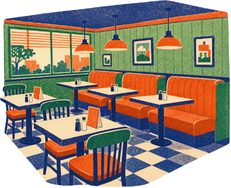
Places like Moon Palace aren’t local staples anymore. These were the restaurants and cafés generations of students could taste just by thinking of them: a booth worn smooth by decades of late nights, or a dish ordered so often it no longer needed to be on the menu.
You might wonder, what happened to Moon Palace and its peers?
Or intuitively, you might already know. Rents increased when their prices couldn’t. Now, they’ve been replaced by slop bowl chains that we’ve all come to know.
It would be easy for me to blame private equity (PE) and leave it at that, but at a university known for producing the smartest, most villainous PE employees, I have some explaining to do.
My personal qualm with these PE-owned and-backed chains—think Dig Inn or Blue Bottle Coffee—is that they try to recreate the very mom-and-pop shops that they’re replacing. They borrow the look of a neighborhood spot: chalkboard menus, maps of partner farms, and neon signs trying to conjure up a warmth that has never been.
But that “warmth” is just part of the product design. Behind the counter, there’s no owner who remembers your order after thirty years of seeing students come and go. There’s a rotating, low-paid army of staff working through a trickle-down script.
Cultural homogenization is the larger issue here. The Guardian highlights the “same-ification” of New York: When the goal is to grow their bottom line, PE-backed restaurants are destined to cut costs, reduce portion sizes, and “reinvent” themselves by adopting a deadbeat aesthetic that incites virality. Every firm reads from the same spreadsheet, so every reinvention results in the same logos, menus, and viral stunts.
Morningside Heights has gone from a melting pot to a mall. Two decades ago, Indian, Mediterranean, and Chinese restaurants were scattered throughout Broadway, paying homage to the immigrant communities moving in. Today, Broadway is full of sanitized touch screens and slop bowls, grooming us all for the nine-to-five.
And of course we can’t ignore Columbia’s role in this homogenization. The University owns two-thirds of Morningside Heights. According to McSweeney, this creates a double-edged sword: While Columbia helped keep small businesses afloat during COVID by forgiving rents, the neighborhood still feels like a commercial ground curated for the University community.
It stood out to me how little Columbia communicates with its community. The University essentially makes unilateral decisions about the restaurants it brings in or moves out, making decisions for the community without actually consulting it. McSweeney cited, as an example, Columbia’s confusing decision to bring Upside Pizza to 112th and Broadway, just one block away from neighborhood mainstays Koronet and Famous Famiglia.
He pointed to the Hungarian Pastry Shop as a respite, explaining its anchoring role for the community. Owned by two generations of Morningside Heights residents, the Shop is loved by anyone I talk to.
And what makes it so dear to our hearts is that it’s rooted in Morningside Heights in a way that no chain could manufacture. So until Columbia listens to its community instead of prioritizing its rent rolls, Broadway will belong to those with the deepest pockets: Private equity.
While I can’t control who Columbia rents out to, I can choose where to spend my money . So, I’ll keep spending my mornings at the Hungarian Pastry Shop—the one line in Morningside Heights that’s always worth the wait.