
Empowered Indigenous Women Can Save the Earth
By Emma Cregan
TW: This article includes mentions of sexual violence.
When you think of impactful women environmentalists, who comes to mind? Perhaps Greta Thunberg, or Jane Goodall—both fervent advocates of conservation. Yet, their paths to environmentalism were rooted in passion. In contrast, for many Indigenous women around the world, conservation is a means of survival.
This distinction points to a deeper problem: Environmentalism has long privileged whiteness as the image of prominence and influence. In contrast, cultural knowledge held by Indigenous women has been dismissed in conservation efforts. Despite being the first to bear the costs of climate destruction, local communities are routinely pushed to the sidelines.
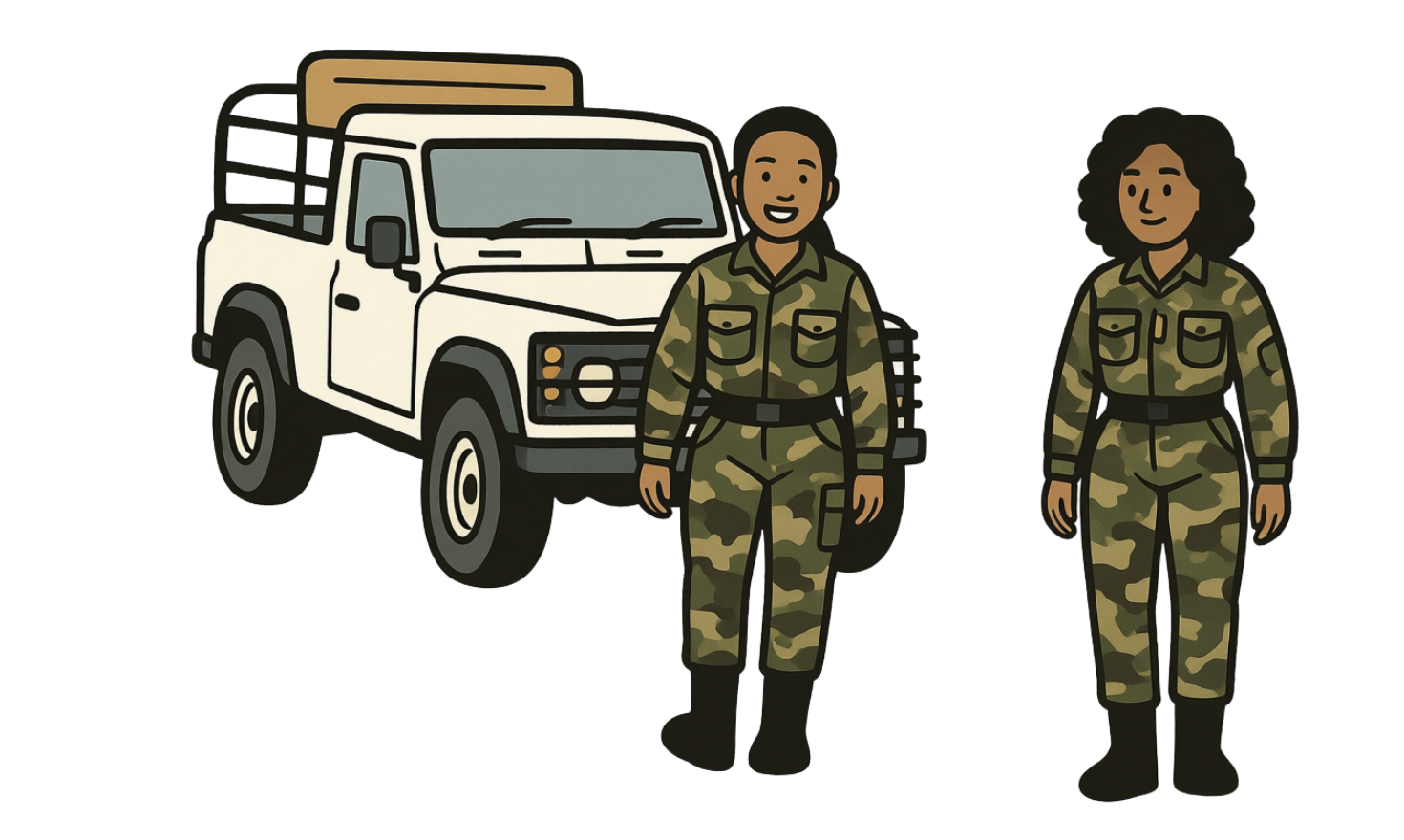
Three women-led groups—the Akashinga Warriors of Zimbabwe, the Black Mambas of South Africa, and the Shenno of India—show the world what becomes possible when Indigenous women lead the way in environmental conservation.
In the Shona language, Akashinga means “The Brave Ones.” Composed primarily of gender-based violence survivors, the Akashinga Warriors are an all-female ranger team operating in the Lower Zambezi Valley of Zimbabwe. Home to the second-largest elephant population in the world, this valley recorded 8,000 elephant poaching incidents over 16 years before 2022. To address this dire situation, local women underwent specialized military training to lead anti-poaching efforts.
Since the Akashinga Warriors intervened, wildlife encounters in the region have increased by 400 percent. Their success also transcended the valley, inspiring women and girls in surrounding villages to join the effort. Akashinga’s impact reframes the powerful nature of locally-led environmental work: Conservation and women’s empowerment can be mutually reinforcing.
The Black Mambas, working in South Africa’s Greater Kruger National Park, exemplify a similar story. This all-female ranger unit protects endangered rhinos while providing vital income in an area with scarce employment opportunities. Financial agency directly translates into community influence: Black Mambas have the means to own property, attend school, and invest in future generations. They’re a testament that economic development and environmental protection can work in tandem to empower women.
In India’s snow-covered Pridi Valley, local expertise is equally indispensable to wildlife conservation. The impact of harsh winters on farming has led local women to begin tracking snow leopards for the Nature Conservation Foundation to supplement their income. Now known as Shenno, these women use camera traps, pawprints, and droppings to monitor 83 leopards in the region. They work at altitudes over 14,000 feet—terrains that would otherwise be prohibitive for outside researchers. The Shenno’s intimate knowledge and skills are crucial for wildlife protection in Pridi Valley.
Rather than platforming one individual, as in the case of Thunberg and Goodall, these programs incorporate entire communities. Increasing investment of the local community in conservation gives environmental movements long-term momentum.
Despite these success stories, Indigenous women are rarely placed in leadership roles in conservation efforts. Instead, their expertise is frequently ignored.
At its worst, they suffer violence at the hands of self-proclaimed climate protectors, following a long history of violence and oppression against Indigenous peoples in the name of conservation.
The creation of America’s National Parks in the 20th century led to the forced removal of Native American populations. “America’s best idea” caused mass displacement of Indigenous people. A racist worldview permeating conservation policy underlies such violent displacement—one that sees Indigenous people as a threat.
Despite the broader discourse and criticism, such injustices against Indigenous populations continue today. Colombia’s renewable energy initiatives use the ancestral land of the Wayúu to install wind turbines. Resulting land conflicts force Indigenous women to abandon property they are entitled to under the matrilineal tenure system. Similarly, the Tanzanian government evicts the Maasai from their ancestral lands in the name of environmental conservation. When their farms are cleared, displaced Maasai women are left without a livelihood and suffer dismal economic and health outcomes.
These injustices reveal a clear historical tension between Indigenous rights and conservation efforts. Western environmentalists treat Indigenous people not as an integral part of the ecosystems they wish to protect, but as an obstacle in their pristine vision of nature. But ecosystems do not become pristine by removing people—such a version of nature does not exist. Indigenous communities developed alongside the environments conservationists wish to preserve. Their culture is inherently harmonized with nature, forming an integral part of the ecosystem they inhabit. The inclusion of Indigenous communities in conservation leadership is therefore not just a matter of social justice, but one of sustainable conservation and a green future.