
After Orbàn
Courtesy/Tristan van der Mieden
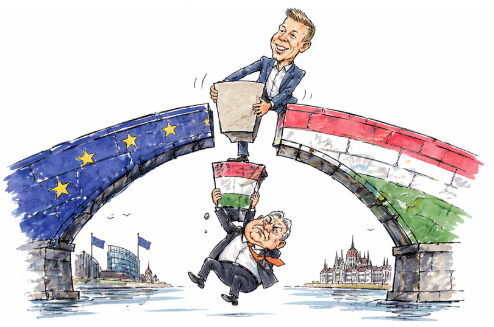
A few weeks ago, on the night of April 12, tens of thousands in Budapest chanted “Ruszkik haza,” or “Russians, go home.” This slogan dates back to Hungary’s 1956 revolution, when Hungarians tried to remove an uninvited power settling in their borders. This time, their own government was the target of that chant.
That day, Viktor Orbàn lost by a landslide after spending sixteen years in office. His opponent, Peter Magyar, won a two-thirds supermajority. This type of supermajority allows Magyar to rewrite the constitution that Orbán spent years crafting to entrench his power. Orbán’s collapse came down to a failing economy, brazen corruption, and his infamous Russian favoritism, which struck the last blow to his political survival. In the final days before the election, records surfaced of a phone where he told Putin he was “at his service.” Hungarian voters had had enough. A populist, it turns out, has to remain popular.
European Commission President Ursula von der Leyen welcomed the result with open arms, saying, “Hungary has chosen Europe,” and she is not wrong. Hungary did choose Europe, but less for ideological reasons and more because Orbán had simply lost his charm.
Magyar—who left Orbán’s Fidesz party because of a sexual abuse scandal—quickly became the front man after joining the Tisza party. He centered his campaign on anti-corruption and basic governance, promising zero tolerance for “systemic corruption” and to “bring politics back to the people.” But he did not do that alone: most of Hungary’s centrist and left-leaning opposition consolidated behind him, turning the election into a head-to-head contest with Orbàn. In a country with a traditional multi-party system, that is incredibly rare. In Hungary, it had never happened before.
Magyar’s policies on Russia and the rule of law favor Europe’s, but he is still a conservative nationalist who ran on fixing a broken state, and that is what the people voted for. On migration, his position is barely distinguishable from Orbán’s, and he does not plan on abandoning cheap Russian oil anytime soon. This was expected—Hungary gets 93% of its oil from Russia. With no equally cheap options on the horizon, changing that now would be highly unpopular at home. While Hungary will not be blocking every EU decision on Russia anymore, the EU still has work to do.
We cannot give Europe credit here. Europe did not fix this. Hungarian voters did, and that distinction matters. The EU spent 16 years watching one of its own members slide into authoritarianism, impede diplomacy, and operate as Russia’s back channel. What eventually removed Orbán was Orbán himself. The EU got fortunate—and good fortune is not a foreign policy strategy.
So it all comes down to what the EU does with this moment. Von der Leyen wasted no time in calling for the abolition of the national veto in EU foreign policy decisions, which is an attempt to ensure that no single member state can hold the other 26 hostage again.
Although the national veto is likely not going anywhere soon, making sure this power is not abused is the first step in making EU foreign policy more effective. However, the bigger opportunity for the EU right now is demonstrating its worth to Hungary and other EU skeptics.
Once Orbán’s backsliding dissipates, the rule of law returns, and the billions in EU funds are released, Hungary’s economy can start catching up. After years of slowing growth, institutional decline, and high inflation, that is a welcome change for Budapest. The EU should show its ability to catalyze that change. Hungary’s energy dependency is a good place to start—they cannot diversify away from Russian oil without serious infrastructure investment. The EU, which still imports around 13% of its gas from Russia, should treat ending that dependency as a shared security priority, as Russian energy imports still generate revenue for the Kremlin as it wages war against Ukraine.
Hungary showed that illiberalism is not inevitable. But the conditions that produced Orbán—economic frustration, a government that stopped working for its own people, and an opposition too fragmented to compete—are still present across Europe. Slovakia’s Robert Fico is already positioning himself to take over Orbán’s old role. Far-right parties are incumbent in six EU member states. The network Orbán spent years cultivating is far from gone. The EU got lucky this time, and it should be honest with itself about that. Whether it seizes this moment to fix the institutional gaps that Orbán spent sixteen years exploiting is yet to be seen.