
Reflections on the Resurgence of Violence Across Mexico
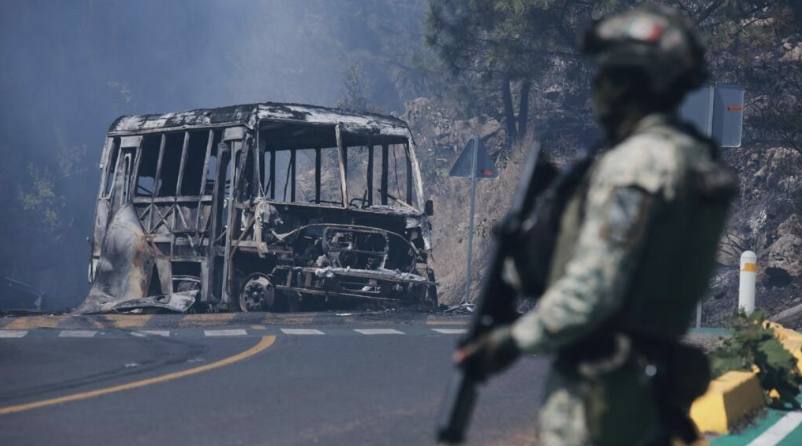
A soldier guards a burned vehicle in Cointzio, Michoacán, Mexico, February 22, 2026. Photo by Armando Solís/AP Photo.
By Ana Paula Meillon Pantoja
The reported killing of Nemesio Oseguera Cervantes, known as “El Mencho,” the longtime leader of the Jalisco Nueva Generación Cartel (CJNG) on February 22, unleashed a familiar, troubling pattern across Mexico—one of extreme violence, narcobloqueos (cartel-imposed roadblocks), and widespread fear among civilians. In the aftermath, the CJNG has terrorized communities and disrupted daily life. Highways have been blocked, vehicles burned, and entire cities placed under siege. These are not isolated incidents; they are coordinated displays of power meant to remind the public that organized crime remains deeply embedded in Mexico’s security landscape.
For non-Mexicans around the world, this may be just another news cycle. But for me, it is a lived memory. I grew up in the Mexican state of Nuevo León during one of the most brutal periods in the country’s recent history. During President Felipe Calderón’s war on drugs, from 2006 to 2012, violence was like ambient noise. We saw bodies hanging from bridges, experienced repeated narcobloqueos that paralyzed my home city of Monterrey, and fell asleep to the sound of gunshots—a sound no child should grow used to.
My childhood experience is not unique; it is shared by many who lived in states affected by this alleged war on drugs. Calderón’s strategy, despite its stated objectives, produced limited durable security gains. Instead, its implementation was complicated by corruption and institutional weakness. It is impossible not to feel fear for civilians living through renewed waves of violence, as memories of my youth echo in today’s news.
Today’s situation in Mexico also presents a persistent policy dilemma. Governments are rightly criticized for legitimizing violent actors when they are negotiating with criminal organizations. Yet when the state pursues and captures high-importance cartel leaders, the country often experiences retaliatory violence that imposes immediate and devastating costs on civilians. Given this, what can Mexico’s government do to minimize civilian harm and produce a persistent security approach rather than fuel cyclical spikes of violence?
Enough is enough.
Mexico’s federal and state authorities must engage in deeper policy conversations grounded in state capacity, even if this will be no easy feat. In the short term, the government’s priority should be harm reduction and territorial stabilization in communities most exposed to organized crime. This requires better-trained and properly screened local police forces, improved coordination between federal and state authorities, and rapid civilian protection measures following high-impact operations. Without immediate capacity to contain violence, civilians will continue to be victims of cartel-led retaliation.
In the long term, preventive and social policy cannot remain peripheral. Communities most exposed to organized crime require sustained investment in education, youth employment, and local development. At the same time, judicial institutions must be strengthened to dismantle financial networks and impunity structures that allow cartels to regenerate leadership. These reforms will not be quick or easy, but the alternative pattern of violence we have witnessed cannot be repeated.
Regardless of the domestic policies that Mexico implements, the international community must also step up. The deeply entrenched transnational political economy enables organized violence to persist. Drug demand in the United States generates extraordinary rents for criminal organizations, while the southbound flow of firearms from the U.S. market significantly increases the lethality of cartel operations. Any ensuing security framework must therefore recognize organized crime for what it is: a cross-border system that requires sustained bilateral responsibility and policy coordination.
As someone who lived through the violence of the Calderón years, I do not see today’s events with analytical distance; I see them through memories. When fear becomes routine, violence goes unchallenged. The lived experience of many Mexicans is precisely why the current escalation should alarm the global community and prompt serious reflection. Mexico does not lack the courage required to confront organized crime—it lacks strong laws, capable institutions, and coherent public policies that can break this cycle and keep civilians out of danger. President Sheinbaum, millions of Mexicans are still waiting for the security and protection they have long been promised.