
The Stranger’s Case: Protestors Rally Thursday at Columbia over Ongoing ICE Raids in Minnesota
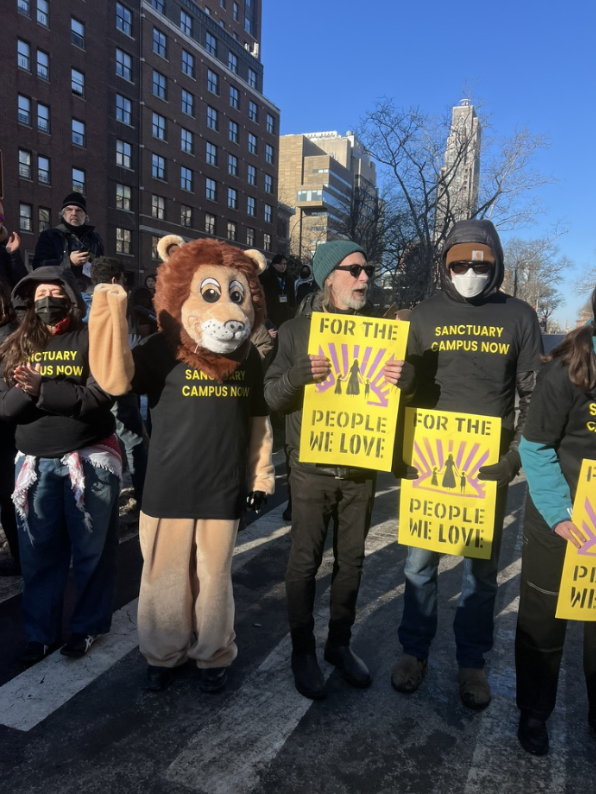
Image Credit: Damian Vladimiroff
By Damian A. Vladimiroff
Columbia students, faculty, and organizers gathered outside the university gates at 116th Street and Broadway on Thursday, February 5, in response to ongoing immigration-related raids conducted by Immigration and Customs Enforcement (ICE) in Minneapolis, Minnesota. The event echoed fears on Columbia University’s campus of a possible escalation of ICE presence in New York City.
Event speakers decried the supposed collaboration between the university administration and city agencies such as the New York Police Department (NYPD) with ICE in detaining students. No counter-protesters were present aside from a camera crew and an interviewer from an unidentified source navigating through the crowd and gesturing to photographs printed on a sheet of paper of individuals who, the questioner alleged, were raped and murdered by undocumented migrants.
By 3:07 p.m., a dozen demonstrators staged a sit-down on Broadway to block uptown traffic, as NYPD officers corralled the crowd back onto the sidewalk in front of Miller Theater. Twelve individuals, including students and staff, were arrested and charged with blocking traffic and refusing to disperse. As of late February, the university has not yet announced whether any affiliated protesters will face disciplinary action. The arrested protesters are set to appear in court on February 23.
The anti-ICE protest reflects a resurgence in campus activist activity since the spring of 2023, when a showdown between the university administration and pro-Palestinian activists culminated in protesters occupying portions of the Morningside campus. Dozens were placed on suspension or expelled following subsequent pro-Palestine protests, and the university administration still restricts campus access for the nonaffiliated public. The demonstrations garnered nationwide attention alongside scrutiny from the Trump administration, whose Department of Homeland Security detained three Columbia international students active in the 2023 protests. One of the protest organizers, Mahmoud Khalil, SIPA ‘24, faces deportation to either Algeria or Syria, pending an ongoing legal battle with the federal administration over the status of his permanent residence.
Beyond Columbia’s gates, demonstrations have sparked nationwide in the last month over ICE’s aggressive tactics in detaining and deporting suspected immigrants in Minnesota. Since the start of Operation Metro Surge in December 2025, federal agents have completed over 4,000 arrests in Minneapolis. While conducting these arrests, agents often encountered protesters and local residents, responding to crowds with asymmetric tactics. In two separate confrontations with Minnesota protesters in January, federal immigration officials shot and killed two American citizens, Alex Pretti and Renee Good. The death of the two neighbors elicited further enmity from Minneapolis residents, the agency’s detractors in Congress, and the Minnesota state government.
ICE resolved to whittle down its operations in Minneapolis following tensions with residents and feuds with state officials such as Mayor Jacob Frey and Governor Tim Walz. In a press conference on February 12, border czar Tom Homan announced that the Trump administration would conclude Operation Metro Surge.
“As a result of our efforts here, Minnesota is now less of a sanctuary state for criminals,” said Homan. “I have proposed and President Trump has concurred that this surge operation conclude.”
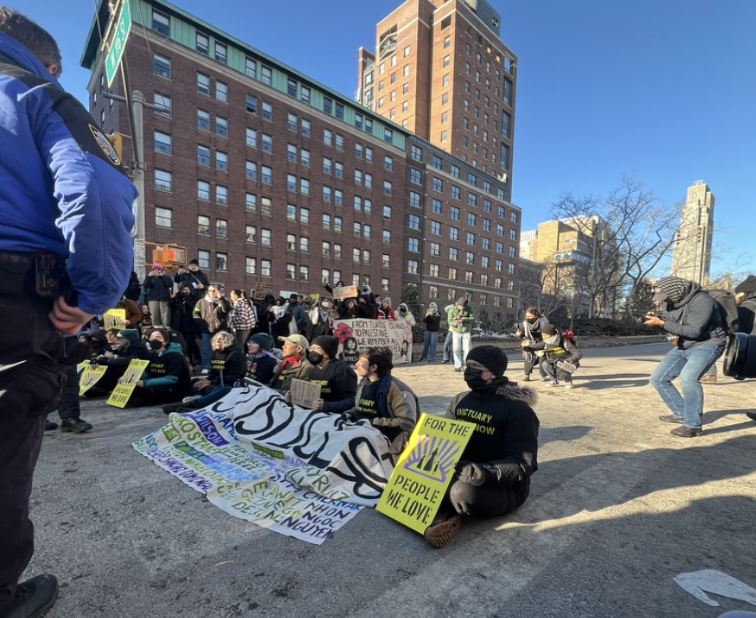
Organizers seen staging a sit-down on 116th Street and Broadway as part of the anti-ICE demonstration. The NYPD took 12 individuals into custody.
New York’s elected officials echoed concerns about ICE’s aggressive operations in Minneapolis. Mayor Zohran Mandani recently criticized ICE and the Secretary of the Department of Homeland Security (DHS) Kristi Noem. “ICE is more than a rogue agency—it is a manifestation of the abuse of power,” Mamdani told a meeting of New York City religious leaders on February 7.
At Columbia, protesters at the 116th St. event carried signs reading “Hands off our students” and “Abolish ICE”, alongside Columbia mascot Rory the Lion donning a black “SANCTUARY CAMPUS NOW” T-shirt. But attendees’ criticism of ICE carried deeper significance, harkening back to the 2023 pro-Palestine protests and the Trump administration’s subsequent retaliation against the university. Many participants wore keffiyehs, and frequent chants against ICE often accompanied those of “Free Palestine.”
“When it comes to Columbia University, the intersection of both issues are clear,” said Cameron Jones, Columbia College ‘27, a spokesperson for the Columbia chapter of the Sunrise Movement that organized the rally. “The three people arrested were detained by ICE for their [work on] Palestine… it is important that we address both issues.”
The university itself has been subject to concern across campus over potential cooperation with federal agencies on immigration and curbing demonstrations the administration disapproves of. Jones further expressed mistrust of incoming university president Jennifer Mnookin’s willingness to shield students and faculty, particularly non-citizens, from possible retaliation for free speech. He cited her tenure as chancellor at the University of Wisconsin–Madison (UW-Madison) in 2023, when she authorized campus police to clear a protest encampment over the Palestine conflict.
However, Mnookin received praise for what others describe as a more moderate and conversant view towards student activism. As Columbia University’s incoming president, she was described by Columbia Board of Trustees’ co-chairs David Greenwald and Jeh Johnson as “a keen listener who builds consensus and does not shy away from making difficult decisions when necessary.” And while responding to student criticisms for forcibly dismantling the UW-Madison encampments, she released a statement distinguishing between freedom of speech through civil disobedience and “mere lawlessness.” The UW-Madison administration eventually negotiated a compromise with Students for Justice in Palestine (SJP), the organization that spearheaded efforts to pressure the university into divesting from Israeli-connected organizations. The deal created leeway for campus groups like SJP to engage further in a “shared governance model with respect to investments.”
Mnookin is set to assume the presidency on July 1, 2026, amid ongoing calls for the university to scrutinize collaboration with ICE and other federal agencies, which Columbia’s administration denies. Ultimately, the incoming president will face a dilemma in simultaneously easing the academic body’s concerns over possible federal incursions and appeasing a Trump administration wary of Columbia’s on-campus activist culture.
“The Trump administration is very erratic in how it acts,” said Jones, concerned about the possibility of large-scale ICE operations escalating in New York City. “The student body is prepared and has mechanisms in place to intervene if ICE and DHS come on campus.”
As it winds down its operations in Minneapolis, whether DHS ramps up the presence of agents in another city such as New York remains uncertain for NYC residents and political leaders alike. Meanwhile, Jennifer Mnookin assumes Columbia’s top leadership position following years of controversy over campus protest culture and a string of interim presidents who faced federal scrutiny. Should ICE surge its operations in New York akin to Minneapolis, the Columbia administration will need to balance its delicate relationship with the Trump administration with a politically outspoken campus milieu.