
In Praise of Imperfect Places
By Isabel Nieh Hou
SIPA is not so bad.
That’s not a particularly popular opinion—for a reason. Indeed, there are countless moments when the institution has fallen short of expectations.
And yet, I can’t help but feel that SIPA has gotten the short end of the stick in the court of public opinion.
Perhaps a better question to ask, then, is this: What would it mean to love SIPA?
I am someone who falls in love with places easily. I enjoy imagining myself in them, picturing a version of my life that fits neatly into their rhythms. It makes things feel familiar, even when they aren’t.
SIPA didn’t feel like that—at least not at the start.
I didn’t attend any of the summer events before starting my first year. I didn’t join the group chats or show up to the pre-orientation meetups. I have been to OSA exactly once. I rarely speak up in class, and I do not participate in the WhatsApp debates. To this day, people ask if I am a first-year or a J-termer.
Coming into my first year, I set my expectations…not very high. Which might explain why exceeding them has felt so marvelous.
It all started with sushi.
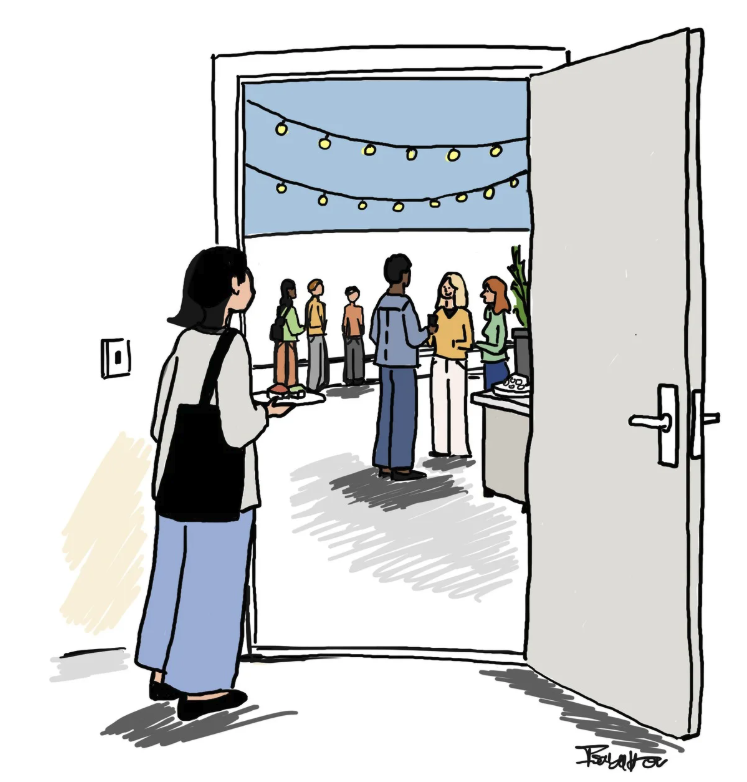
During orientation, I heard about an event: “Sushi Under the Stars,” hosted by the Technology, Media, and Communications specialization (now the TPI concentration). There would be sushi. There would be a patio. I was sold. I said goodbye to International Organizations/UN Studies, switched to Technology, Media, and Communications, and showed up ready to eat.
I didn’t know much about the topics of conversation—artificial intelligence, technology governance, and emerging risks—but I stayed anyway. One dinner party led to a conversation, as one class turned into another. Slowly, my life at SIPA began to unfold.
I found myself in classes I never would have imagined taking, like Ethics of Tech, Media, and Design, where I went down a Waymo rabbit hole and wrote about surveillance in autonomous vehicles. That led me to research on post-AI deployment incident monitoring, which I hadn’t even known existed a few months earlier. I applied to The Morningside Post board. I painted covers, created illustrations, and worked with a team to bring a print publication back to life.
In every instance, I didn’t expect to contribute much. But people talked to me. They encouraged me. They made it feel possible to stay. And those small decisions—to show up, to stay—ended up changing more than I could have expected.
Very little of this is attributable to the SIPA that’s advertised in brochures and LinkedIn ads, or the curriculum itself (apologies to any Economics professors who taught me). The SIPA I’ve come to love grew out of a rather cavalier lack of expectation, an open mind, and a bit of whimsy. In return, SIPA gave me so much that I did not expect: People who saw something in me before I saw it in myself—professors who encouraged me to stay in rooms I wasn’t sure I belonged in, mentors who pushed me to take myself a little more seriously—and made it matter.
And that is what I’m grateful for most: proximity to people. People from different countries, different cultures, different ways of seeing the world. People whose relationships to places run deeper than my own. Being around them has changed how I think about where I am, and how I move through places I visit and belong to.
There’s a kind of love they carry for the places that shaped them that isn’t simple. There is criticism and attachment, frustration and loyalty. It reminds me of the James Baldwin quote: “I love America more than any other country in the world and, exactly for this reason, I insist on the right to criticize her perpetually.”
This kind of love is more nuanced, more difficult than what many of us are used to, but I would argue that if this can be done right, it is the deepest form of love that exists. It rests on a belief in a place’s potential, its endurance, its ability to survive what is difficult, even what is unjust. That, increasingly, is what SIPA asks of us.
I believe in SIPA on its good days and its bad days—and we’ve had many of those. I believe an orientation event can accidentally change the course of your life. I believe in The Morningside Post. I believe in walking from the fourth floor to the sixth floor. I believe in Publique bento boxes. I believe in a successful SIPA boat cruise (too far?).
I believe in us, and what we might become.
So maybe, when you look around IAB’s gray walls one last time, you’ll find something—just one thing—you believe in, too.