
What Employees Want From Leaders, and What They Are Not Getting
by Adhiraj Singh & Tatevik Barseghyan
At a time of mounting global uncertainty, democratic backsliding, and institutional strain, old assumptions about leadership are harder to sustain. In many public-facing institutions, the idea of a successful leader is often attached to performance: results, efficiency, execution. But when people describe the leaders they actually want to work with, a different picture appears. They value strategy and decisiveness, but they also expect fairness, integrity, trust, and psychological safety.
That tension is exactly what our recent collaborative study on leadership set out to examine. The study surveyed employed individuals across Armenia, India, and the United States to compare how people think about leadership in different settings. We chose these three countries to reflect different democratic and organizational contexts, while honing in on a question that reaches well beyond any one place: What kind of leadership do people actually want, and where do organizations fall short?
Rather than asking respondents to rate every leadership trait in the same way, we asked them to make trade-offs between traits. For example, do they prefer a “decisive” leader or an “empathetic, trustworthy” leader? We sought to understand what traits people value most and what they feel is missing in practice.
Some findings were not surprising. Across all three countries, people still want leaders who can think strategically and make decisions. No one argued that performance does not matter. But it was only part of the picture.
The sharper message concerned the gap between what people value and what they experience. Again and again, the core issue was not leaders’ ability to deliver results. Results orientation was the most overdelivered trait in all three countries, showing the largest positive gap in each context. The shortfalls were concentrated in fairness, integrity, accountability, trust, and conflict resolution, with a few country-specific exceptions. Organizations often seem better at getting things done than thinking carefully about how things get done.
Clear, thoughtful, and responsive governance matters in any workplace. But it especially matters in policy, academic, and public-service settings, where people work across hierarchy, expertise, and uncertainty. In these settings, trust and fairness are not soft extras. They actively shape whether people raise concerns early, question weak ideas, work through disagreement honestly, and help institutions avoid avoidable mistakes that affect livelihoods.
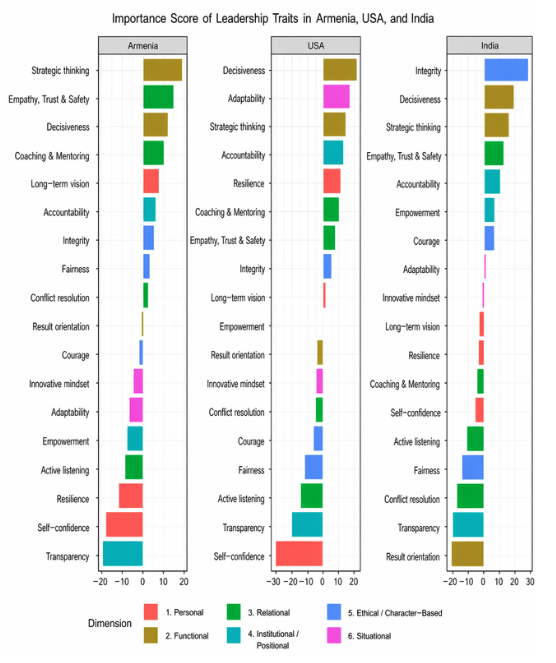
Some of the deeper findings from Armenia reinforce this broader point. Clear differences emerge by age, gender, organizational role, and sector. Women report significantly larger leadership gaps, especially in courage, trust, psychological safety, and inclusion, while men generally evaluate leadership more positively. Conflict resolution is one of the clearest leadership shortfalls for both women and men. Leadership dissatisfaction is highest among younger employees and declines with age; however, ethical and relational gaps persist across all age groups, pointing to a systemic issue. Private-sector leadership is rated stronger on strategy and results but weaker on ethical and relational dimensions. Public sector leadership aligns somewhat better overall, yet both sectors continue to struggle with fairness, conflict resolution, and decisiveness. Perceptions improve with seniority, but gaps shift rather than disappear: Non-managerial staff report the strongest ethical and relational deficits, while top managers point to weaknesses in strategic direction and decisiveness.
So what should institutions do with this information?
First, leaders within organizations should weigh factors beyond outcomes and speed more heavily, such as fairness, accountability, and psychological safety. Second, manager training should put more emphasis on practical trust-building and conflict resolution, not only on delivery and performance. Third, organizations should regularly ask whether the leadership qualities people value are the ones they actually experience in everyday work.
The good news is that leadership skills are not trade-offs. Strong leadership is not a choice between strategy and empathy, or between decisiveness and fairness. Instead, our findings—despite being exploratory—suggest the inclusion of new priorities: the most resilient organizations are usually those that combine execution with ethical and interpersonal credibility.
For students, practitioners, and institutions thinking seriously about leadership reform, the lesson of our study is not that results matter less. It is that results and values must be able to coexist. If organizations want healthier teams and stronger institutions, they have to stop treating integrity, fairness, and psychological safety as optional qualities and start recognizing them as central to leadership itself.